How to weigh gold and jewelry at home
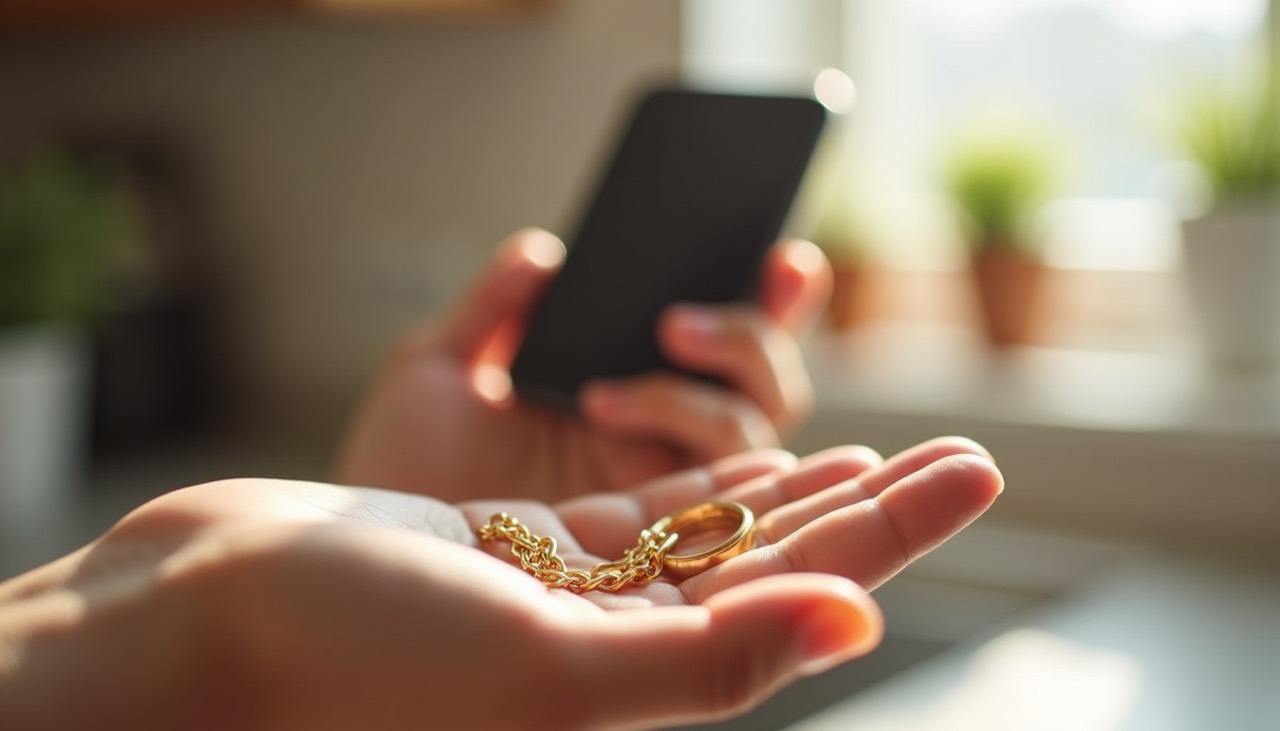
Knowing how many grams your gold weighs helps you understand what a piece might be worth before you sell, insure or buy it. Here is how to get a good idea at home — with your phone, with simple household tricks — and when you need a jeweler's certified scale.
Quick estimate with your phone
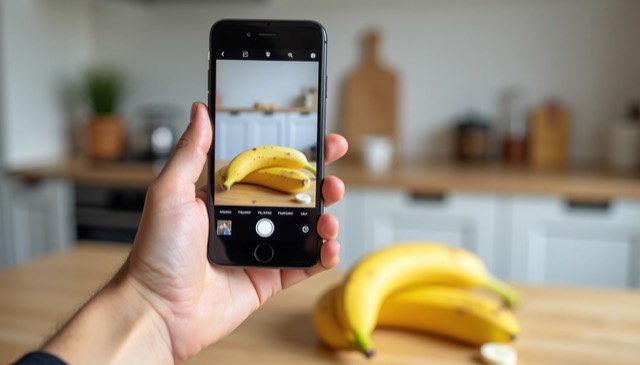
Scale For Grams estimates the weight of jewelry from a photo. Place the piece on a plain surface or on your hand, add a coin for scale, and take the picture from above. The app identifies the item and its likely material and returns an estimate in grams.
Remember that gold color alone doesn't prove solid gold: plated, hollow and gold-filled pieces weigh much less than solid gold of the same size.
Typical weights of gold jewelry
| Item | Typical weight |
|---|---|
| Thin wedding band | 2–4 g |
| Wide or men's wedding band | 5–10 g |
| Thin chain (45 cm) | 3–8 g |
| Medium chain (50 cm) | 10–25 g |
| Stud earrings (pair) | 1–3 g |
| Bangle bracelet | 10–30 g |
Weights vary widely with width, thickness, karat and hollow construction.
Gold density: a check for solid gold
Pure gold has a density of 19.32 g/cm³; 18-karat gold is about 15.2–15.9 g/cm³ and 14-karat about 12.9–14.6 g/cm³. A jeweler or a precise scale can measure the item in air and in water to calculate its density, which helps reveal plating or hollow parts. This test needs an accurate scale, so it is usually done at a jeweler.
Household tricks
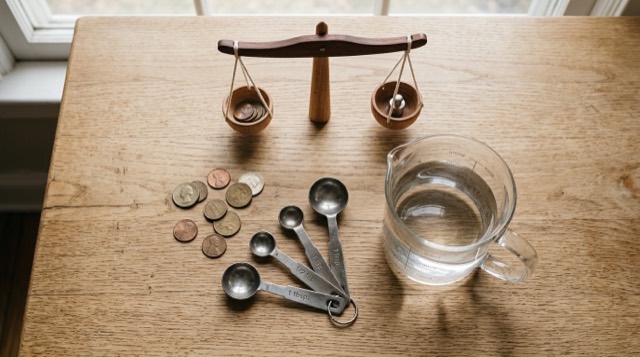
- Balance with coins: a simple balance with coins of known weight (for example a US nickel weighs 5.0 g, a 1 euro coin 7.50 g) gives a rough number.
- Compare with a known piece: if you know the weight of one ring, compare others of similar size and style.
When to use a jeweler's scale
For selling, buying or insuring gold, always rely on a certified jewelry scale, which measures to 0.01 g, together with a karat test. Use phone estimates to prepare: know roughly what to expect, so you can spot an offer that seems too low.